Showing posts with label markets. Show all posts

Thursday, January 08, 2015

Crude Shocks keep India in Smiles

“The economics of oil have changed. Some businesses will go bust, but the market will be healthier,” says the Economist (December 6, ’14). Is this the beginning of cheap oil regime or just an interlude between two big bumps?

2013, in retrospect, had turned out to be the strongest year of recovery, with growing US Economy and stabilizing Chinese economy. Commodity prices were projected to remain flat with an up-side risk due to unexpected supply-side shocks.

Enter December 2014 and all the projections seem little more than wishful thinking. IMF went on record recently: “the global economic growth may never return to pre-crisis levels” ! All the Quantitative Easing (QE) from the US (3 till now – totalling over $ 4 trillion or, twice that of the entire Indian economy) which was supposed to push cash to banks ended up just in increased valuations and stock indices accompanied by higher prices of gold and other commodities. Emerging economies like India had to contend with high inflation. Some even said: it is ‘US Fed exported inflation’!

Now we’re in a scenario where

Thursday, January 20, 2011

Strong China Growth - Bullish / Bearish ?

Like I said in the last post - these are interesting times indeed...Please consider the two news articles given below.

The first one is dated 14th of December 2010, and talks about the day when Asian stocks rose due to China reporting strong growth numbers. It says:

"Asian stocks advanced on Tuesday, supported by optimism that China would avoid aggressive moves to curb inflation that could inhibit its strong economic growth and blunt its voracious demand for raw materials."

Compare this to the second one which is dated today, 20th of Jan 2010, and talks about how Asian markets tumbled when China said it grew by a robust 10.3% in 2010. It further says:

"China said its economy grew 10.3pc in 2010, marking the fastest annual pace since the onset of the global crisis but concerns about persistent inflation sent Asian markets tumbling."

What a difference 28 - 29 trading days can make ! Inflation was high then, is high now. Interest rates haven't been raised during this period, although liquidity has been sucked in through increases in RRR - the reserve ratio requirement which mandates banks to keep a certain percentage with themselves as cash and not give it off as loans.

It doesn't end here though. The first article goes on to say:

"A Reuters poll released on Monday showed economists still see a rate rise in China in coming months, but expect policymakers to rely more on lending controls in 2011 as its weapon of choice in the fight against inflation."

...while the second goes:

"Analysts said the pick-up in growth in the fourth quarter - partly driven by stronger exports - and the still-high inflation in December supported the case for further interest rate hikes and bank lending curbs."

Apparently now the markets are really sceptical about interest rate hikes coming up...quite a bit of change of view from the previous one !

Like I said before...interesting !

Wednesday, January 19, 2011

Goldman Sachs on BRICs v/s US Markets

An interesting article in the Telegraph on Goldman shunning BRIC (Brazil, Russia, India and China) nations for US markets for better returns this year. Just thought I'll evaluate this news literally...and here's what I've managed to come up with, please take a look at the following charts of global indices and how they've moved over the last 6 months:

(Click for a sharper image)

Notice among all the markets in the world, namely, US, France, Korea, Canada, UK, Australia, Brazil, India and China, only the latter 2 are actually in a downtrend right now, the rest are actually at or well above their support levels.

The reasons are fairly well publicized, Inflation and an economic hard landing for China and Inflation and fiscal deficit for India. Inflation is the common major worry in both the economies though. China is rumored (conservatively speaking) to suppress its actual inflation figures which some believe to be in early double digits...and for countering a growing distress among local lower-middle class population, it has raised salaries for government employees twice in the last 1 year...and that too by over 20% each time! This is in turn putting an upward pressure on the salaries of their peers in private organizations in China, thereby hurting their wafer thin margins.

India is a worse story in Inflation, recent ads in newspapers and TVs are from poultry chains showing the marginal price difference between vegetable and poultry products...and asking people to make a better choice ! Some people are reportedly even switching to fruit diet as they are almost as costly as vegetables here. Although unlike China, the liquidity is quite tight here, asset bubbles not as great and the banking industry much more robust, but with the government racing down to find the depth of moral bankruptcy through various scams over the last 1 year, its an overall fairly uncertain scenario, which is something no investor will like.

It'll be interesting to see how things unravel from here...will China really crash? Will India see a major correction from here? Will the US economy rebound? Will EU stabilize thus sending gold southwards?

But then again, always keep in mind the (potential) vested interests of such investors, and that there have been times when they have given an outlook for $200 / barrel of crude oil (when oil was $122). Crude eventually went to $147 and then turned back to touch $35 in less than a year. These are interesting times indeed.

Tuesday, January 11, 2011

Indian Markets - down but not out, Trading Strategy

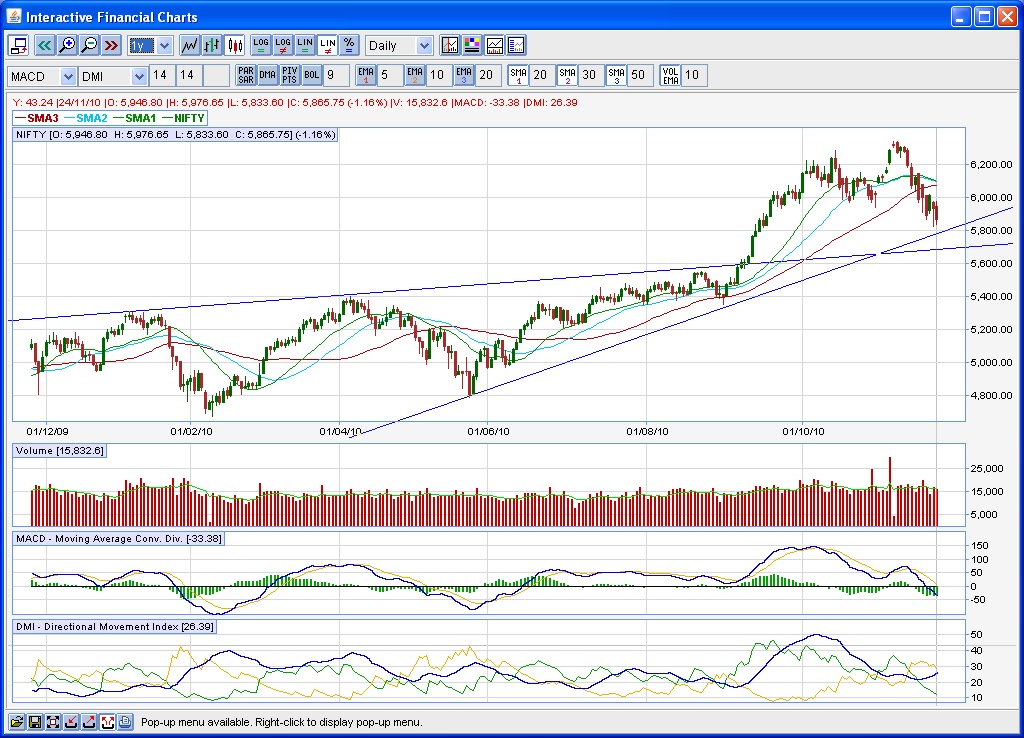
Its amazing to see a strong unidirectional trend in the markets...this time its down ! Consider this, from the start of this year, Nifty has gone down by nearly 7% while some others like Bank Nifty and CNX Realty have shed over 10% and 12% respectively !

Here's the chart for Nifty:
(click for a sharper image)
And for Bank Nifty:

(click for a sharper image)

The reasons for such drastic fall are apparently the flight of hot-money from India in the backdrop of strong consumption / demand and reduced unemployment numbers being reported from US and rising default risks in EU region again reminding investors further about the relative sustainability of the US.

The flight of money from India is also reflected in the USD INR Chart of the last 5 days (see chart below). Notice how INR has moved from 44.4 to nearly 45.4 in just 5 days...in currency markets, that's a HUGE movement.

(click for a sharper image)

China's inflation worries and its continuing stress on further rate hikes is keeping the entire Asia Pacific region on tenterhooks for an impending crash. Besides, China has been coming under increasingly higher pressure to let its currency appreciate in order to help US and Europe cope with their crisis better, which if it happens, would be disastrous for most markets as it will lead to China crashing.

However, I think given the strong 200DMA supports coming up for both Nifty and Bank Nifty, the fall should take a breather here. Moreover, with China reporting a trade surplus (net of Exports - Imports) of nearly USD 13 bn for Dec 2010, (which happens to be much lower than what it was last year in the same quarter), it is in a better position to bargain for slower / no increases in yuan (CNY) during meeting with Barack Obama on Jan 19 this year. [Keeping its currency weak will help China in boosting its export value, and thereby increasing its trade surplus. Ditto for US, which is going to be one of the points of discussion during the meet] Such a bargain (though US is unlikely to give it) will help China immensely in keeping itself from a crash, which will be a good boost to Asian markets.

Besides, with US pumping in more money into the system through its currently on QE II, China is going to find it tough to increase interest rates. This is because if it does, it'll boost what is known as the "Yuan carry trade". The term Carry trade was earlier associated with Yen, wherein, given the near zero interest rates in Japan, investors used to borrow in Yen and invest in foreign markets where interest rates were higher, thereby making a neat sum in this simple arbitrage. For China however, increasing interest rates will bring in even more from the US where the rates are currently near zero. This will further pump up the money supply in China boosting inflation further - which is the last thing China wants at this stage. This will, among other factors, keep China from increasing the rates too much, too often...and it is more likely to contain inflation by sucking liquidity out of the financial system (by increasing reserve ratio for banks, making loans to real estate more difficult, etc.).

Given this scenario, I'd suggest another trading strategy for this month...to sell a Strangle. Sell Nifty Jan 5700 put for 87 and sell Nifty Jan 6100 call for 15.4. This will result in a net inflow of (87+15.4) = 102.4 * 50 units = 5120. If Nifty ends up between 6100 and 5700, before 27th of Jan (another 12 trading days) the entire money is yours.  The break-even points would be 5598 and 6202. Beyond these points, you'll end up losing 50 bucks for every point. Keep your stop-losses in place and trade.

See my earlier trading strategy and its follow-up here.

Disclaimer: No positions as of now. But be aware of the risks...I'm not a trader by profession and don't claim to have any expertise in either trading or recommending trading strategies.

Wednesday, December 22, 2010

Dope 'em - Dec, Jan Effects of Markets

Just some of the similar events that took place simultaneously across the world:
  • S&P 500 Index Climbs to Pre-Lehman Bankruptcy Level 
  • Seoul shares hit 38-mth high as worry eases
  • European shares hit 27-month high
  • Nifty crosses 6k, Sensex crosses 20k after 5 weeks
  • Nikkei hits 7-mth closing high on bargain hunting
  • Copper and Cotton also moved up higher, Coffee jumped to a 13 year high (its definitely on caffeine !)

Apparently, the reasons for all these highs include:
  • China backing the efforts put by Euro zone to contain the crisis (like there was an easier choice to make; besides, is China signaling a similar action being taken under similar circumstances is justified for them as well?)
  • North Korea has backed away from threats to retaliate against the drill
  • Mining companies rising on higher metal prices, (helping European shares edge higher)

Saturday, December 11, 2010

Some Questions for 2011

Fidelity has released a list of questions, pretty interesting ones...(HT: Pragmatic Capitalism) so I thought I'll try and answer some of those...and raise some of mine as well. In this post, I'm only going to pose the questions...I'll need time to compile these answers, which I'll post as a follow up post just before the New Year...and compare notes with the markets by the end of next year.

These are really interesting questions...and like someone said, a lot of times its the Question that's more important than the answer...! Take a look at the questions, all related to markets, global economy, etc. and think about them...If you would like, let me know what you think about some of these questions....
============================================================
  • Is Euro zone going to fall apart? Will Euro cease to exist as a currency?
  • Which countries in Euro-zone are getting into trouble next? Will anyone default?
  • How will the currency war be played out between US and China?
  • Will the US Economy recover?
  • Are Gold and Silver the new proxies for currencies? Will countries start dealing in Gold and shun dollar completely?
  • Will the bull run in commodities continue?
  • Will emerging markets (EM) remain the driver of global growth, even though China and other countries are counteracting the Fed’s monetary policy?
  • Will Inflation in EMs come down?...And finally,
  • What is the outlook for INR-USD and Nifty?
============================================================
    Now, each of these could be a research topic, but I'll try to answer as many as I can before new year...and also try and keep it simple...Please let me know if you'd like me to include something else in this list.

    Tuesday, November 30, 2010

    How would you like your Markets - Shaken or Stirred?

    Ok, this post isn't about connecting Markets and Bond, though Casino Royale did attempt that...Its about re-looking at major factors that can move the markets from here in either of the 3 directions (sideways is also a direction ;)).

    Post QE II (where US released some USD 600 bn to induce growth into the system), everyone and their pets were bullish on the emerging markets and inflation in some pockets thereof. However, Chinese counter measures for preventing money flowing in freely into their system, combined with the Europe crisis, has clearly shown the world the other side of the coin. Where do we go from here, is a question people have started asking again now.

    So I thought I'll compile a list of global and domestic (India centric) factors that can affect the markets significantly in either direction:
    • European Crisis: 
    Although Ireland has agreed to the bailout by IMF, Portugal and Spain have already started to look bad if we take cues from the bond markets. Ireland story is not done yet though; it looks like they got the raw end of the deal - IMF has gotten them to agree on spending their Pension Funds first (for repaying their debt which is coming due soon) and only after that they should touch the 1st dollar (or Euro) given by IMF. What this implies is by the time Ireland gets to spend IMF money, they are already bankrupt...and hence completely dependent for quite some time on IMF. Irish are not very happy with this...protests will happen, heads will topple, and may be, just may be, terms and conditions will be re-looked into.
    Portugal is not as big an issue as Spain - given the massive difference between the size of their economies. Its like saying I have a tooth-ache...may be a tooth has gone bad and needs to be pulled out...and o yes...I have brain tumor too...but thats not aching so much...!
    Spain is a bigger problem than Portugal, and this time around, the markets are not waiting for crisis to come up before it tanks again. Money is flowing out of Europe. And to top it all, there are some bank runs being planned as well (No, I'm not kidding!). December 7 is being planned as the day when civilians across Europe are getting together to take out all their deposits from various bank accounts...(read this article from Zero Hedge). That means banks had better spruce up their cash levels to meet sudden surge in requirements, and if they don't...well, we'll know which banks were naked behind the curtains ! Can't say how much support is there for this cause, but it's been on for quite some time now. [As an aside, Wikileaks has said that early next year, they're going to do a big leak on a major US Based bank...read here. So if we miss solid action on banks in Europe on Dec 7th, we can still look forward to action from US banking circles early next year.]

    • Inflation:
    India and China are reeling under severe inflation...(while US is praying it'll have some of it !) and are unable despite all their efforts to bring it down. They are also growing at a scorching pace...India has grown @ 8.9% last quarter as compared to 8.2% in the same quarter last year. Indirectly, the growth and inflation impact is even causing intermittent cash crunch in call-money markets in India (these are short term borrowing markets, in which companies borrow for 1-3 days to tide over their working capital gaps). In fact, RBI has recently made some temporary changes to CRR to infuse more liquidity in the market to cool down the lending rates in call-money market. Too much of inflation and uncontrolled growth always poses a risk of a hard landing...bringing in crash scenarios for markets to consider. If these scenarios persist, RBI is quite likely to raise interest rates / suck out liquidity from medium term perspective (especially by clamping down on lending to Real estate sector), which will further push the markets down (though not lead to a crash).

    • Currencies
    Dollar is clearly appreciating against all major currencies...very unlike what was envisaged just some time back. Euro is retreating...and no big support will come in till clarity comes in on the extent of crisis in the rest of Euro zone. China, Russia, Brazil, some other SE Asian markets have started trading in their local / preferred currencies apart from Dollar, as "Dollar is better than Euro" is not being seen as a convincing argument by markets. India is not a major market in the world, in fact, it is not even a significant part of the portfolio for many major funds, who, anticipating more scams, hard landing, might take money out of the markets, pushing rupee further down. Export lobbyists wont complain though. But its not that all's well for dollar from here, as soon as Europe crisis is played out / contained, dollar too will take a hit, 'coz fundamentals of US economy are not exactly confidence boosters.

    • Interest Rates, Growth cooling
    Interest rates are very likely to continue hardening in China and India, both to cool down inflation, contain growth, and avoid adverse effects of QE II money flowing in. Meanwhile, other SE Asian economies - Singapore, Thailand, Indonesia, Malaysia, are too cooling off. And "Japanese economic growth" has long been accepted as an Oxymoronic term, like Military Intelligence - the words exist separately, but sewn together, mean nothing. Every time high-growth economies like China increase their interest rates (there is already talk about another increase, after the recent one), commodity prices are going to take a huge hit, and so are equity markets (partially due to contagion effect, and partially due to prospects of reduced growth). A lot really depends on how central banks act at this stage...the question is no longer whether, rather how much, and when.

    There are some other such factors, but I believe these are the ones with most far-reaching consequences. So while most of the factors are pointing towards a gloomy scenario, its still too early to write off the bullish scenario for the markets that we had envisaged earlier. It all really depends on how each of the above factors plays out...and how well or badly the central banks tread the thin line between inflation and growth. US too is not out of the woods yet...it just keeps postponing its problems, right from contingent liabilities of social security to medical expenses, from unemployment to huge fiscal deficit...

    The time is running out for Europe, US,...at some point of time, something's gotta give...just then we'll know really how decoupled we are from the developed world...till then...stay tuned to the markets, and never forget to take cues from the Bond markets - for its him who'll tell whether the markets will be served shaken or stirred.

    Wrap Up - Scams, Markets, Bonds, Currencies

    I was on a 4-day vacation, so could not post anything, but managed to keep in touch with the latest happenings. So much has happened that I think I'll have to skip a few topics - mostly related to Scams...but a quick word on those nevertheless:

    Medianama has given some really interesting links (HT: Deepak Shenoy - Capital Mind) to audio files and transcripts of conversations between Niira Radia and several prominent personalities like Ratan Tata, Ambanis, A Raja, Barkha Dutt, Vir Sanghvi, etc. Fairly interesting read / listen, depending on how much you like to hear the now famous "All India Radia" ;)

    And now, back to the markets - Ireland has finally accepted the $ 113 bn EU bailout package with severe austerity measures, which is obviously not going down well with the civilian rights groups...markets are not impressed, the Dow is down over 1% at the time of writing, and the focus has now shifted to Spain and Portugal (yes, already !) The Spanish 10-year bond yields rose 0.14% to 5.35% and that of Portugal rose 0.09% to 7.23%. Bond yields increasing means bond prices are going down - markets, expecting higher risk of default, are willing to pay lesser for a "secure" government bond. This will typically hit the Mark to Market (M2M) of treasuries of banks and central banks who are large holders of these bonds - for them, the value of a prime part of their portfolio just went down...who may then be needed to set aside some more capital to make up for the losses...for which they sell some other country's bonds...and so goes the contagion.

    As an aside, the yields on 10-year US Treasuries is approx. 2.83% and that of India's is around 8.03%...so technically, India is far more likely to default than Spain / Portugal...but unlike these countries, India still has the power to print its own currency (INR) and pay back the debt in the worst case scenario (although that would trigger hyperinflation here, but thats a separate story altogether).

    Meanwhile, after a brief respite during the Ireland bailout talks, Euro continues to slide against the dollar. Here is a quick recap of the last 1 month's euro-usd movement:

    (Chart: Courtesy Yahoo! Finance - Click for a larger image)

    It reinforces the fact that market players are not yet completely done with Europe with Ireland bailout news...they would like to get a sense of where it all is going before coming back into the markets - in the meanwhile, they'll keep selling stocks and taking money out of European markets...leading to slide in both - European markets and euros.

    Similarly, INR has also weakened against the dollar considerably over the last few days...a glance here as well:


    A similar logic here as well, though default is not the top-of-the-mind topics for India, one scam after the other is rocking the markets, resulting in a few exits as well. Both euro and rupee have hit a 2-month low...can't really say how much lower they can go from here.

    But to me, overall markets look good to go up from here...am still going with what I've said in my earlier posts...but beware of Bank Nifty, banking stocks, and of course, realty...

    Thursday, November 25, 2010

    Nifty, Markets, Trading Strategy

    LIC Housing Finance Scam really knocked the steam out of the markets which were showing all signs of reversing a trend yesterday. However, I think it should be better today, Banks though still have some more downside left. But overall, Nifty should move up from here, as it has a strong support coming up at 5850 levels, with another decent support coming up at 5750.

    A quick look at the same chart that I've posted in my earlier posts here and here:


    Overall markets will continue to remain cautious, with Ireland bankruptcy possibility still lurking around the corner and new issues like the N/S Korea war creating further jitters. But overall, I don't think in the times of geopolitical distortions, currency wars, protectionism, etc, a military war-game is required...there are better and more advanced tools available now to kill an economy ! So expect markets to gradually tide over these news, and focus on the regulations, policies, dictats...for these will be driving the world for some time to come.

    Just a quick word on the trading strategy for Nifty, i think selling a Dec 5700 put (currently at 95) should work out in this scenario as Nifty looks unlikely to breach 5700, in which case time decay will take the value out of this instrument. Aggressive traders can even look at selling 5800 puts.

    (Disclaimer: Please do your own research before taking any positions. I am not a trader / investment advisor and may have vested interests in recommendations).

    Saturday, November 20, 2010

    Musings - II

    Finally, as expected, China has raised bank's reserve ratio by 0.5%, which means that the Chinese banks will have to deposit an additional 0.5% of their total deposits with the Chinese central bank. This is expected to suck out nearly USD 50 bn from the Chinese financial system, which will help in keeping inflation in control / even reducing inflation. 

    Now, this move is mostly to account for excess cash flowing in from the US, courtesy US Fed (QEII - in which US is printing over USD 600 bn of paper currency). But US is going to release this money in phases till April next year...so expect China to keep an upward pressure on interest rates and RRR (Reserve Requirement Ratio) to keep absorbing this money.

    As yet, RBI has kept quiet regarding reaction to QE II funds flowing in into the Indian economy. However, if RBI feels "compelled" to do something about it, they will also likely hike the reserve ratio to suck out liquidity from the system, just like China, and not  tinker with the interest rates as it will directly hit the growth rate.


    [Also, regarding such opinions given in Economic Times "...Realty Stocks are showing signs of life"...if I were you, I would not believe it much, 'coz if RBI takes any liquidity tightening measures, realty stocks will be the first to go down.]

    Besides, Europe's problems are far from over...once the Ireland insolvency issue is sorted out, Poland / Spain will crop up...probably in that order ! And once again the world will be looking at Euro as an unsustainable currency and the ensuing chaos.


    These factors, in my view, are going to be some of the biggest factors in keeping upward moves in markets in check...As I've pointed out in my previous posts here and here, the markets are expected to move down some more before pointing up. RBI still shows no signs of doing anything about curbing the inflow of QE II money, which will probably be the stance till the IPO  / FPO calendar is mostly done (MOIL, SCI, SAIL, ONGC, EIL, OIL, and some more) coming up between now and March 2011. So expect some see-sawing in the markets for the next months...with markets going up with QE II money pouring in and coming down as China increases its interest rates  giving markets jitters about the demand. I don't know (or think) if the markets are going to go majorly in any direction in the near term (now - 6 months), but I think the volatility is going to increase from here.

    Wednesday, November 17, 2010

    Markets, Currencies, Gold and Geopolitical Equations

    Trust markets to save the surprise element for a well-drafted climax. The stage was all set for a thriller action-packed movie whose story was supposed to be something like this:

    US Government reduced interest rates, encouraged borrowing, created asset bubbles, and made people believe that bubbles are here to stay...everyone and their grandmothers minted money where ever they put their investments...everyone's happy...then came crisis, 'something's gotta give' proponents were proved correct - and then...Lehman happened...all hell broke loose...Intermission !

    US released approx. $ 1.7 tn of funds into the markets, bailed out "too big to fail" institutions, and things started improving...some jolts came from Europe's crisis pockets, but they too were managed by showing strength of confidence and trust in Euro and Euro-zone. But as time elapsed, people realized things were not improving...jobs were still getting lost...growth was still anemic, foreclosures were still setting newer records...and the US Government (better known as G'mint by now), was under pressure again. US G'mint has to seem to be doing "something" in the face of obvious debacle in mid-term elections.

    US Federal reserve releases money into US's banking and financial system, thinking they'll be able to spur growth and depreciate their currency against others - giving them a double benefit (dollar depreciation helps US in improving exports, eases interest payments on debt)

    Meanwhile, the economists and analysts, both independent and attached to large investment houses worldwide denounce the policy...(with yours humbly included in this crowd) and prophesy that dollar will depreciate against all currencies, all right, but US financial system will die a slow death, (ok there was a divide here with some calling for a deflation), and all other assets in all other markets will shoot up...(of course, no Top for Gold in sight)

    And out comes the market, with the final verdict - the worst of both worlds - Euro crisis breaks-out first, US dollar appreciates (like Zero Hedge wrote in one of his posts - People see it as a Bullish sign for dollar that US will default Later than Europe !). Markets worldwide tank...China raises its interest rates in anticipation of free dollars flowing in...Euro loses value, all commodities go down, markets tumble, even Gold tanks...The End !

    I know that its still too early in the day to talk about the "outcome". We're still quite far away from playing out the entire game. On these lines IceCap Asset Management has come up with an excellent (and funnily sarcastic) view of the overall game-plan (HT: Zero Hedge)...(you can see the Nov 2010 report from Icecap here). A small preview of what's in this report:

    With the QE2 announcement now out of the way, Mr. Bernanke’s game plan is as follows:
    1. Lower interest rates for "everybody" and "everything"
    2. Stocks & Bonds will then increase in value making "everybody" and "everything" feel wealthier
    3. "Everybody" will then start to buy "everything"
    4. Pray that the price of "everything" doesn’t increase too much and therefore cause "everybody" not to buy "everything"
    5. If steps 1 to 4 are successful, businesses will begin to create jobs for "everybody" because they will once again be buying "everything"
    6. Ignore the housing market problem
    7. Ignore the debt problem
    8. Ignore the effect of numbers 6 & 7 on the banks
    9. Pray that foreigners continue to buy newly issued American debt
    The report is a good read...please do take time out to go through it.

    The point here is, the crisis in Europe has not gone away...and again predictions of who's next (after Ireland) have started pouring in...neither has US taken the right step by taking on more debt to get out of their debt trap, and they will pay for it sometime or the other...there is an increased coordinated activity globally on debasing dollar as the world's reserve currency, on acquiring Gold by central bankers - either through market or stealthily through un-announced mines acquisitions...the banks are on the edge again, with over 900 banks closing down in US alone in the last year or two, (and expectations from European banks are no better)

    The way it is, (HT: John Mauldin - for giving this perspective) its not really about the markets / asset bubbles per se, there is a larger game at play here - that of Confidence and Trust. Confidence on Governments, on Growth, on policies and policy changes...Trust between banks and FIs, between countries, between two counterparties exchanging commodities for Dollars. At a really broad level, its a Geopolitical failure...with Governments not taking enough / correct steps, thinking of their economy as mutually exclusive from that of trading partners and global economy... In the past as well, many recessions were due to lack of confidence and a complete break-down of trust...even the crisis that started in 2008, was triggered when banks stopped trusting each other with their money...that's when the financial juggernaut stopped rolling, and government pushed in money thinking it'll lubricate the system and things will be smooth again...

    Like Soros said recently, the "new world order" is emerging...lets hope once the game is played out completely, we'll make a fresh start with Confidence and Trust.

    Monday, November 15, 2010

    Margin Requirements hiked - Effect on Global Markets

    There was one other point that I did not cover in my last post (Rumblings of Markets...), due primarily to 2 reasons - one, the post was getting too long for audience's perceived comfort (in my view) and two, this is a lesser known, less talked about, but an extremely important point nevertheless, which needed a separate coverage.

    And the point is about exchanges increasing margin requirements on various contracts.  Margin requirement is the minimum amount that a trader needs to deposit with her broker / exchange in order to take a futures contract. This is apparently being done to remove some of the speculative money from the markets. We'll jump in into the dense world of commodities, but first, some news for those of you who have skipped this important piece.

    As per Bloomberg, "Ice Raises Margins on Sugar Futures by 9.9% as of Close Nov. 12" which lead to a sell-off in raw sugar prices that was so sharp, that it beat all records set in the last 22 years ! Simultaneously, ICE also increased margins on cotton, leading to a 2.7% sell-off. CME raised margins on soybeans, while Chicago exchange did so for Silver (which tanked 7.1% later). If you would like to, read this good piece from WSJ Online here.

    Back in 2006-08, when authorities in India accused commodity futures for pushing and keeping prices of physical commodities higher, the ones who did not support this view said that futures prices are in fact determined by the physical prices. So if sugar demand goes up / supply goes down, the mandis / local markets will push the physical prices of sugar up, and thereby the futures prices will also go up since physical prices are an input to calculating futures prices. If this does not happen, there is an arbitrage opportunity which allows prices to come back in sync. This is another way of saying that the tail (futures market prices) cannot wag the dog (physical market prices).

    But going by the events listed above, it seems like the futures prices were actually being held up to some extent by speculators and it wasn't entirely tied to physical prices. Such a sharp sell-off in various commodities underlines the fact the speculative money can in fact, keep the prices artificially high. The margin money is the life-line of traders, its what they calculate ROI on, its what is churned n times a day to make money. E.g. if we assume that the margin required for  1 futures contract is around Rs. 25000, a trader with Rs. 50000 will be able to take only 2 contracts in either 1 or 2 different assets. On the other hand, a trader with Rs. 10,00,000 (ten lakhs) will be able to take 40 such contracts. Assuming both are normal, disciplined traders, its an easy guess who will make more money. Thus, margin money determines your churn, which affects your profitability directly. Any increase in margin money requirements slows the churn cycle so if 0.5% daily returns were good earlier with X margin money, nothing less than 0.75% daily return is good with 1.5X margin money.

    Besides, the margin money requirement also has a contagion effect: You need more margin money, you decide to pull out some money from some other trade, ----> that asset prices goes down, ----> traders holding that asset get margin calls ----> they sell something else -----> that asset prices goes down...and so on. Besides, stop losses start getting triggered, which leads to further sell-off, leading to further downslide...and so on...not just in the same market / asset class, but in others as well.

    This is probably one of the major reasons (apart from the ones given in my last post), which has lead to a sharp sell-off in various asset classes across the globe. It looks likely that this sell-off will continue for some part of next week as well, till traders re-align their portfolios again.

    But notice how all these margin requirement hikes are happening across exchanges across geographies simultaneously...giving an eerie feeling of an implicit dictum from the big daddy of commodities...(but its just my guess, I could be entirely wrong here). Also, notice how these requirements have been upped in commodities which China imports heavily...(sugar, cotton, soybeans). [Co-incidence anyone?] 
    They have good reasons to do so - one, they are faced with inflation issues just like in India (any they're hoping that this move will cool down prices which will be reflected in lower inflation figures), and two, with their currency appreciating against dollar, their exports will take a hit and so they might have wanted to make some downward adjustments to their import bill as well (to keep trade deficit in check). If these are indeed the reasons, expect margin tightening in more commodities, in more markets.

    There is just one thing which can derail the above tactic - the producers / sellers of these commodities, who will not be very happy with the falling prices (some of these players are really really big in the market). Besides, typically, their sale contracts are not based on end-of-day prices, but more on monthly average / quarterly average prices, which will come down drastically with the effect of such falls. Also, with falling prices, the chances of defaults by the buyers increases drastically (not very uncommon) further putting in question the actual sales figure done by these producers / sellers for this month / quarter.

    Expect these players to come back big time to push the prices back up again. If they need to borrow money to put in the markets, they will. Expect banks to increase their lending to these guys and to usual trading companies to make good their increased Working Capital Requirements (due to payment of higher margin money). Whether and how soon the prices come back up will really depend largely on such players in the market. 

    But till then, it'll be the case of the tail wagging the dog.

    Saturday, November 13, 2010

    Rumblings of Markets bumbling, tumbling & crumbling

    I don't know whats' scarier, that so much has happened to the markets in just a couple of days OR that this happens so frequently. This post looks like its gonna be a long one...so I'll start with listing down the dots, and then spend some time connecting them...followed by some philosophical discussion ;). Stay with me on this one, for its gonna have some links to very good documents and other blog-posts as well.

    Some of my select picks among many data points:
    • China Market tumble 5% on Interest Rate Increase:
    The People's Bank of China increased its lending interest rates by 25 basis points (0.25%) to 5.56% - its first increase since 2007. The central bank is expected to follow suit this week-end or early next week. This is apparently being done to rein in inflation which is a major cause of concern in China. China has obviously timed it to offset dollars flowing in from the QE II release, and there are talks of another rate increase before the end of this year. Markets see this as a dampener to growth, and future investments in the markets so the markets tanked over 5%, its single biggest loss since Aug 2009. A snippet of what went on in the Chinese markets on 12th Nov (courtesy: Bloomberg)


    • Commodity Markets tumble: 
    Crude Oil, Sugar, Soybeans, Corn fell sharply on news of interest rate hike from China. The markets are expecting a slow-down in demand of various commodities due to increase in interest rates (interest rates are usually increased to rein in inflation, as people save more (to earn more interest) and spend less - thus this kind of move takes away free-money from the system, clamping demand and thus reducing inflation). If you would like to read more about this, read it on Mish's blog - here. As per LA Times, sugar fell 11%, gold 2.7%, copper 3.2%, and soybeans 5%.

    • Ireland's debt crisis spooks investors:
    The PIGS (Portugal, Ireland, Greece and Spain) are back in news. Apparently, investors are getting worried about Ireland's ability to repay its debt, and mirroring this sentiment are the bond markets worldwide, which sent the Irish bonds prices tumbling resulting in difference in yields between the Ireland and German 5-year bonds to a record 6.6% (yields on bonds increase when bond prices go down - which they do in such times when sovereign rating suffers (country doesn't seem to have money to repay its debt) or if prospects of interest rates reduction in future are higher - more on this in some other post). But EU was quick to come out with some reassurances (here - a post by Calculated Risk) which calmed the markets down to some extent. Read a good article on this from WSJ here
    However, this news did cause quite some worry to global investors who pulled out their money from equity and commodity markets - not really because Ireland is a large economy but due primarily to the fear of contagion effect, i.e. If Ireland defaults, Portugal and Greece might get in a worse condition than they are now (since they hold substantial amounts of bonds from Ireland) and if they too default, so will Spain, and then so will France and Germany - the two biggest countries in the EU...and then down goes Euro - triggering a global currency crisis. (I know it seems like a doom's day scenario, but if markets are taking these thoughts into consideration, its scary to sense how close we might be to this turning into a reality). [Another good post for further reading by Mish here]

    • Euro falls against Dollar, then pulls back some:
    Spooked by the Ireland debt crisis, the Euro fell sharply against dollar but recovered a bit after the regulators made some reassuring statements. If the focus again moves towards evaluating the sustainability of the Euro-zone as a region, and Euro as a sustainable currency, dollar may not fall against other currencies as was widely believed post QE II (that's a release of USD 600 billion by US Federal Reserve into the banking and financial system to spur markets and growth).

    Now, the essence of the above picks is that there is no single path post QE II - this path was thought to be something like this:

    Fed Releases Money (QE II - USD 600 bn) ----> US doesn't have fundamental to absorb this cash ----> Money finds its way into other markets (China, India, Brazil, Russia, Korea, Singapore, etc.) and other asset classes (real estate, commodities) (as a result of all this dollar selling and buying of local currencies, the latter goes up against the former) ----> Markets worldwide move up, so does Gold ----> Inflation (as imported by US) increases in world markets ---->US starts exporting more to feed that growth (as with depreciated dollar, US goods become cheaper; also, US interest payments (huge now, even bigger in future with a strong dollar) feel lighter for the government)----> US economy recovers due to jobs returning, fueling demand ----> World markets increase interest rates to rein inflation ----> Markets tank ----> Dollar moves out ----> Local Currency appreciates ---> Exports pick up ----> Economy picks up....
    Now, that's more or less the holy grail of the markets, and economics.

    What has instead happened (from the little data unraveled so far), is that the cycle has skipped some middle steps ...

    Fed Releases Money (QE II - USD 600 bn) ----> Fearing inflation and asset bubbles, China increases interest rates to rein potential / future inflation (a precautionary measure)----> Markets tank ----> ....???

    Just like life, markets too are in a hurry to catch up with the end...but all said, this puts a big question mark over how things are going to unravel post QE II. An excellent post by Mish (again) on this here.

    And with this, the age-old questions are here to haunt us again - Is this the end of the beginning or the beginning of the end? Have we topped out on markets? On Gold? Should we completely get out? But stay in cash ? Which Currency?

    My take is, (atleast for Indian markets) hang-on...we have good supports coming up a little further down from here...domestic demand is still intact...asset bubbles (real estate, indices) aren't of enormous proportions as in other countries...Inflation is a concern but regulator is taking measures occasionally to rein it in, Gold - well, a good hedge for its strong fundamental factors is a possible depreciation of dollar against INR. We'll have to be cautious, alert, nimble...as things pan out better in the open.

    Till now, the normal approach was seen as US Fed release money ---> US markets improve ----> US Economy recovers....(as expected by the US Fed)...

    And the contrarian approach was that this will not happen....instead the dollar will depreciate, US will not benefit from releasing money, other countries will...and so on.

    But with the developments in the markets during the last couple of days, the contrarian approach really seems that Gold will go down, emerging markets will go down, dollar will appreciate against most other currencies, etc. 

    At the end of it, the funny thing with taking a contrarian approach is, if you're taking a contrarian approach without knowing how many contrarians are there in the market, and if there are too many contrarians in the market, which one is the contrarian approach, really? 

    Think about it...I will...!
    Leaving you with some food for your thoughts...

    Friday, November 12, 2010

    Follow-up - Currency regulations, markets

    A quick follow-up to some of my earlier blog posts:

    Earlier I wrote about impending regulations due to currency crisisit might be worth noting the slew of opposite opinions coming in from PM's Economic Advisory Council (here), which categorically denies the need to have any new / additional regulations to be put in place to stop the flow of free money coming from US into India. Another one supporting that argument, Stephen King (from HSBC) says, India may not need to have such regulatory measures to be put in place...and the same can be done by tightening lending to real estate and other such measures.

    Going by the recent minor depreciation in INR vs USD, looks like the markets support this view...but I'd still keep an eye open for this, for this'll affect the markets in a far bigger way that any other single fundamental factor. Besides, with RBI giving optimistic estimates of inflation coming down by December, markets might just be in a wait-and-watch mode...'coz if the inflation doesn't come down as expected / projected...RBI might put in some regulatory measures to prevent the flow of cash from US. But overall, for now, this news is a kick on my back - side !

    In another post, I wrote about the markets not looking too good for another rally immediately. From that time, Nifty has moved down from 6300 levels to a little under 6100 at the time of writing this review. 200 points on nifty - not bad ! (pat on my back).